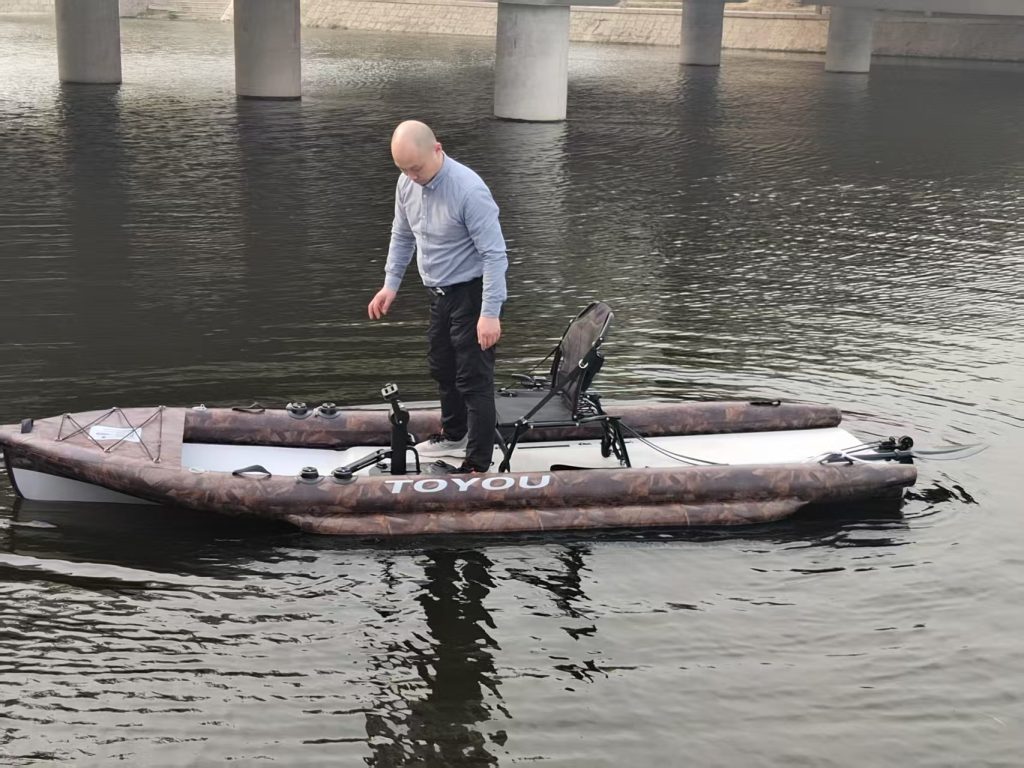
Inflatable fishing kayaks have come a long way in recent years, with advanced designs bringing them closer to the performance of hard-shell kayaks. One such design upgrade is the V-hull front — a pointed, angled bow that changes how the inflatable kayak handles in the water. For anglers looking for better tracking, speed, and efficiency, this feature can make a noticeable difference.
What is a V-Hull Front?
A V-hull front means the kayak’s bow is shaped like the letter “V,” with a sharp entry into the water. This contrasts with flat or rounded bows, which tend to ride on top of the water. In an inflatable fishing kayak, the V-hull is often created by reinforced drop-stitch materials or high-pressure air chambers that hold a rigid shape once inflated.
Advantages for Fishing
1. Improved Tracking and Straight-Line Paddling
When you’re paddling to a fishing spot, especially in open water, a V-hull cuts through the water and keeps you on course. This reduces the constant need for correction strokes, which means less effort over long distances.
2. Better Performance in Choppy Water
The pointed front helps part the waves rather than slapping against them, which reduces splash and makes the ride smoother. This can be a big plus for anglers fishing in coastal waters or large, windy lakes.
3. More Efficient Paddling
Because the V-shaped bow reduces water resistance, you’ll expend less energy to reach your fishing grounds. This is especially helpful when carrying a lot of fishing gear or when you need to move quickly between spots.
4. Increased Versatility
A V-hull inflatable fishing kayak can handle multiple environments — from calm inland lakes to slow rivers to inshore saltwater fishing. The shape gives it enough agility for narrow channels while still offering stability for fishing.
Things to Consider Before Buying
- Stability vs. Speed:
A V-hull improves speed and tracking but may feel a bit less initially stable than a flat-bottom kayak. For anglers who stand up to cast, checking the kayak’s width and secondary stability is important. - Material and Build Quality:
Look for heavy-duty PVC or drop-stitch construction for rigidity and durability. Multiple air chambers improve safety in case of a puncture. - Length of the Kayak:
Longer kayaks (12–14 ft) with a V-hull track better and move faster, while shorter ones are easier to maneuver in tight spots. - Fishing Features:
Rod holders, gear mounts, anchor systems, and storage space are just as important as hull shape when choosing your fishing platform.
Best Situations for a V-Hull Inflatable Fishing Kayak
- Long paddles to remote fishing spots where efficiency matters.
- Coastal or bay fishing with light chop and current.
- Large lakes where wind and waves are common.
- Mixed environments where you want both maneuverability and straight-line performance.
An inflatable fishing kayak with a V-hull front blends portability with improved paddling performance. For anglers who fish in varied waters — from calm lakes to breezy coastal areas — this design can offer the extra speed, tracking, and comfort needed for productive fishing trips. While it may trade a bit of primary stability compared to flat-bottom designs, the benefits in handling and efficiency often outweigh the drawback, especially for paddlers who prioritize covering more water with less effort.